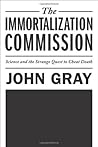
John Gray (2011)
A book of two parts, neither of which exactly works as intended.
The first part deals with spiritualism, the outbreak of belief in the afterlife in the late 19th century. In particular, Gray focuses in on the idea that one could channel the dead through “automatic” writing, a stream of consciousness that would occasionally produce lucid passages that could be attributed to dead spiritualists fulfilling their commitment to make contact after their deaths. “Attributed,” that is, by people who knew them well and could subjectively recognise their style. Unsurprisingly the movement never achieved its goal of “proving” survuval after death, and it’s hard to see how it could ever have done.
The second part segues into the aftermath of the Russian Revolution and the Bolshevik quest to preserve Lenin’s body after his death (this was organised by the Immortalisation Commission of the book’s title). There are also Bolshevik intellectuals who try to construct a more “socialist” theory of life after death, without ever admitting that this can be an actual reality, which would be an affront to materialism and also very dangerous in the face of Stalin’s firm intention to being the sole arbiter of what Lenin would have thought on any subject. But the main body of the second part is more concerned with politics, especially the interactions with the British in the persons of HG Well, RH Bruce Lockhart, and a further cast of spies and spoofers who seem to move in and out of the Russian shadows.
But where is the “science” of the title? It’s here that things go badly wrong. Grey takes the view that “science” is a free-standing entity pursuing a goal of human perfection, and that this is not only doomed to fail but profoundly immoral and leading to false hopes. And so all the detail and arguments presented earlier in the book are revealed to have been a set-up, making a case for the futility of experiment and the quest for knowledge.
Gray has form in this, of course. In Straw dogs he also tries to demolish the idea of science by treating it as a monolithic belief system rather than as it actually is: the constantly evolving best current explanation of how the world works. As such science is not a system susceptible to Gray’s attempts to discredit it once and for all. I disagree profoundly with what Gray attempted here, but I still enjoyed the vignettes and historical exploration.
2/5. Finished Tuesday 5 May, 2026.
(Originally published on Goodreads.)